


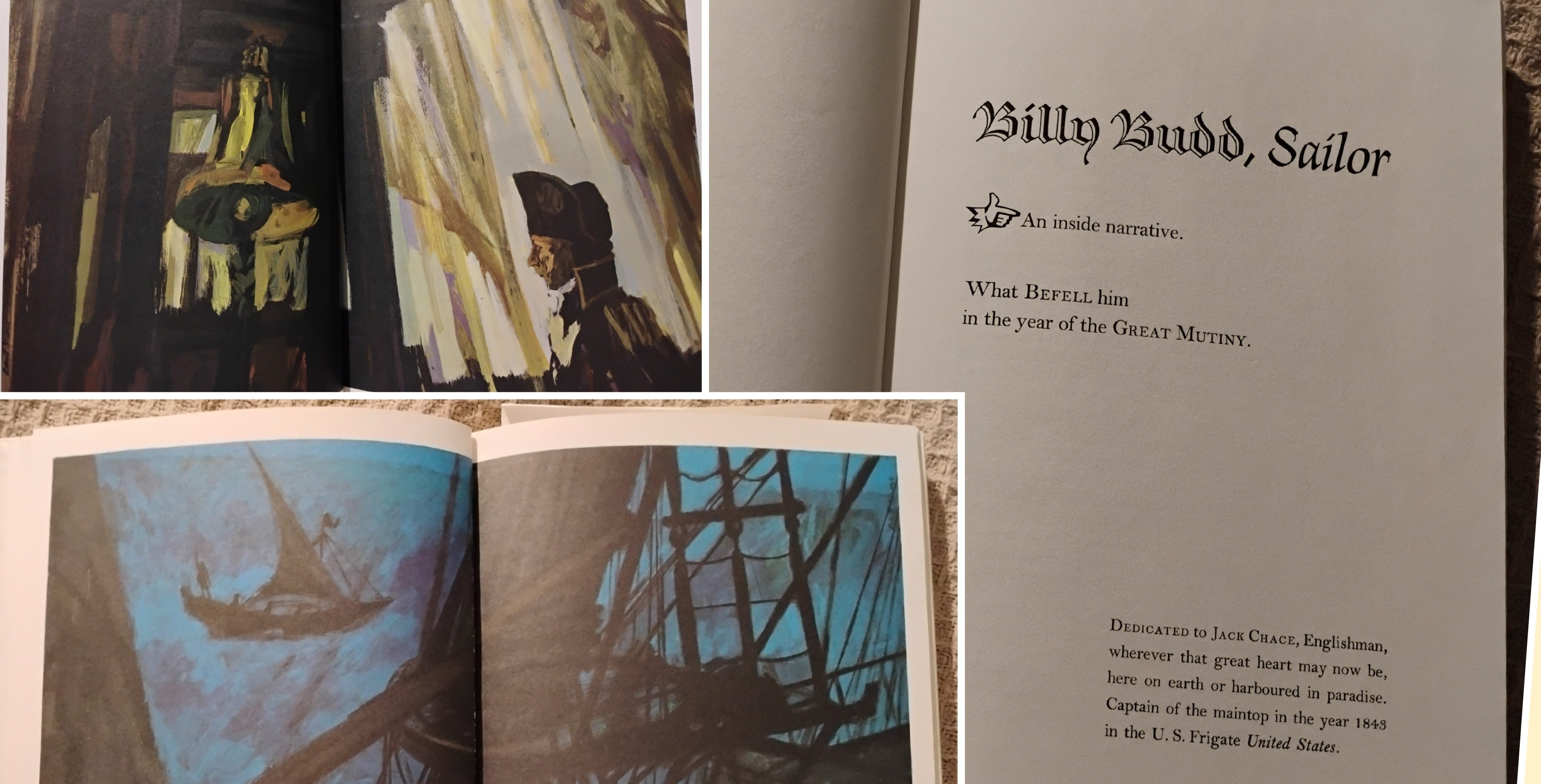
There are those unique works of literature that cast a spell over us, an enchantment that only grows more potent with the years and the re-reads. They haunt us. Often, these works have not only compelling characters and atmosphere, but remain something of an enigma, so that each re-read brings out new insights, new vistas for the imagination. These works might contain strong elements of the allegorical, because every setting and character is somehow larger than itself; all this, while spinning a great yarn with fully-fleshed characters. The central characters, like the foremast, mainmast, and mizzenmast of a ship on which the entire story’s rigging is hung, are not only fascinating in their own psychology, but seem to represent several different philosophies of thought and action. It is in the consequences, or acting-out, of these philosophies that the story moves forward, whether to a heroic end, or a tragic one, or both. One of the most obvious examples of such a book is Herman Melville’s masterpiece, Moby-Dick—a book whose Shakespearean grandeur, with all its Hugo-esque digressions, I am fully prepared to become obsessed with over the coming year. But the work that is far less discussed but which is perfect in its unfinished glory, was nearly lost to history: Billy Budd, Foretopman.
Masterpiece in a Bread Box
During a very special reading of Billy Budd in 2022, along with the Frank Muller audiobook while I was on a family trip by the sea in Newport, Oregon, I took six pages of typed notes on the little book, and couldn’t manage to write even a fraction of all of the scriptural references that I’d caught. (Was Melville immersed in Luke’s Gospel at the time?) My now-husband Boze read it with me from a distance, and so we shared our insights, and we now celebrate the 7th of August, when we started the read, as “Billy Budd Day,” and August—Melville’s birth month—as “Melville Month.”
It is odd to think of this short novel as being “unfinished,” as I would be loathe to change anything in it, but so it is. And it continues to intrigue and mystify. It has been adapted on film; an opera based on the novella was written by Benjamin Britten, with a libretto co-written by E.M. Forster. Though overshadowed by the great Whale, Billy Budd still haunts us.
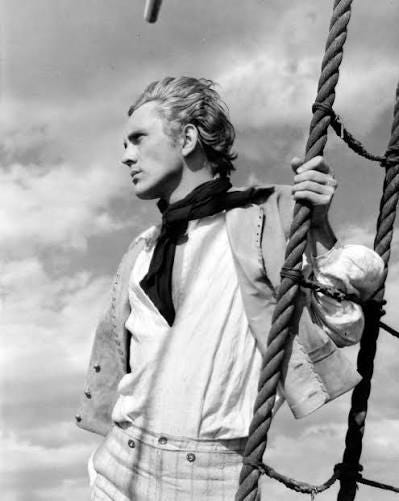
SPOILER in video:
Melville worked on Billy Budd during the last five years of his life, and it remained unpublished until nearly thirty years after his death. Thankfully, Melville’s biographer, Raymond Weaver, was given access (in 1919) to manuscripts that had been stored in a bread box by Melville’s wife, and then passed down to family members. Among them was a chaotic, unfinished manuscript, still untitled—though a title Melville had pondered for it was Billy Budd, Foretopman. It is very difficult to find an image of this box online—my husband and I have plans to see it in person next year when we visit my brother in New York—but there is a wonderful Substack article by Adam Mellion on it, with images provided by the Berkshire Athenaeum in Pittsfield, MA, whose “Melville Room” stores many Melville manuscripts and “the world’s largest collection,” according to the website, of his personal memorabilia, including the precious and plain box.
Billy Budd: The Story
It is the year 1797, and our story, little more than a hundred pages in print or three hours on audio, surrounds the incidents on board the HMS Indomitable, a “seventy-four” ship of the line captained by the Honorable Edward Fairfax Vere.
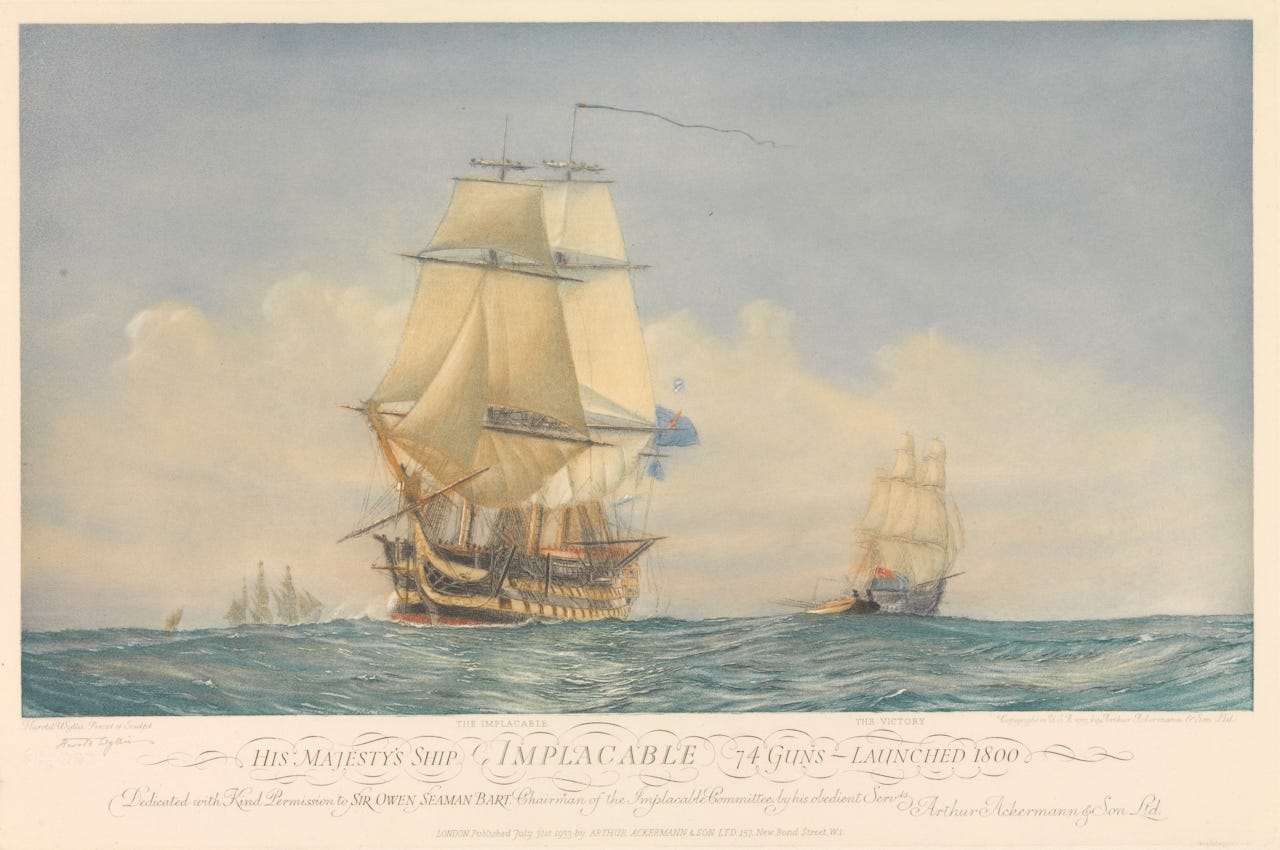
During the Spring of that same year, the Royal Navy had suffered a series of mutinies, notably at Spithead and at the Nore:
“The mutinies were extremely concerning for Britain, because at the time the country was at war with Revolutionary France, and the Navy was the main component of the war effort. There were also concerns among the government that the mutinies might be part of wider attempts at revolutionary sedition...”1
Wariness and paranoia, therefore, about potentially treasonous action aboard ship was at its height, and the pressure to make an example of any who were considered insubordinate was extreme.
Billy Budd, an illiterate young foretopman, was press-ganged into service, and recently was taken into the Indomitable. His beauty, goodness, and lack of artifice make him almost universally popular, and he is known as the “peacemaker” of any ship he is on. Billy has a quality of almost primordial innocence and lack of suspicion. However, he sometimes stammers in his speech, particularly under intense emotional strain. So, when the malicious Master-at-arms, John Claggart, envious and with an inexplicable malice towards the young foretopman, accuses Billy to Captain Vere of mutinous intent, Billy is so astonished and upset that, unable to defend himself in speech, he inadvertently strikes Claggart, his superior officer—with dire consequences.
The Father (Vere), the Son (Billy), and the Accuser (Claggart): Reflections on our central characters
Note: In writing a few reflections on the marvelous characters and situation set up by Melville, I will attempt to shy away from revealing the very ending of the story until later in the writing, and I will put a “spoiler alert” ahead of it.
Billy Budd, Foretopman
“He could not read, but he could sing…”
“...and like the illiterate nightingale was sometimes the composer of his own song.”2 I am always struck and moved by this line about Billy, one of the first things we know about him. He could not read, but he could sing. This line almost strikes the ear—as much as the eye, in print—in a poignant way, suggesting that this very young, uneducated, almost childlike man has something in his nature that is more sublime and poetic than the ordinary person.
Melville, full of the knowledge of the Bible and Shakespeare as he is, suffuses the tale with scriptural references. He compares Billy to another Adam before the fall: “Billy in many respects was little more than a sort of upright barbarian...such perhaps as Adam presumably might have been ere the urbane Serpent wriggled himself into his company.”3 Attestations to Billy’s innocence of heart abound in the story. He is affectionately referred to as “Baby Budd” by fellow members of the crew; he is known as the “Handsome Sailor” or “welkin-eyed” or “Beauty”; he is referred to as a “peacemaker” on board ship, as his character exerts this peaceful influence on others; he was “a sound human creature, one to whom not yet has been proffered the questionable apple of knowledge”; he is referred to as a “cynosure” which, according to Merriam-Webster, is not only a “center of attraction or attention,” a point of admiration, but even, the “North Star.”4
Where does a Billy come from? But even his origin story is unknown to himself, foundling that he is, as we learn in Chapter Two:
“Billy, at the capstan, was being formally mustered into the service. Asked by the officer, a small brisk little gentleman, as it chanced among other questions, his place of birth, he replied, ‘Please, Sir, I don’t know.’
“‘Don’t know where you were born?- Who was your father?’
“‘God knows, Sir.’
Struck by the straightforward simplicity of these replies, the officer next asked, ‘Do you know anything about your beginning?’
‘No, Sir. But I have heard that I was found in a pretty silklined basket hanging one morning from the knocker of a good man’s door in Bristol.’”
Not that Billy is without a flaw, or that he doesn’t have all the consequences of that problematic human nature that has resulted from what John Henry Newman called the “aboriginal calamity”—i.e., the “fall.”5 Billy has “an occasional liability to a vocal defect,” a stammer that prevents him from saying what he intends to. In his frustration or anger at his inability to communicate at times, or at injustices, Billy can strike out, physically. Based on Billy’s challenges with social interaction and his inadvertent impulses when provoked, it has been posited that Billy might be what we would now call “on the spectrum.” Whatever the case, he is something of a Christlike figure in that he is a “sign of contradiction” and a “stumbling block” (Luke 2:34; 1 Cor 1:23). He is also a barometer of the character of others: we can tell a lot from a character by how highly they prize him, whether they love him—or whether he is the object of others’ inordinate envy, dislike, or willful misunderstanding.
Fascinatingly, Melville suggests in the second chapter that even Billy’s flaws, because they harbor in one so pure, are indicative of the greater Story behind the story; they are reminders that there are malignant forces trying to undermine the good in this fallen world:
“In this particular Billy was a striking instance that the arch interferer, the envious marplot of Eden, still has more or less to do with every human consignment to this planet of earth. In every case one way or another he is sure to slip in his little card, as much as to remind us—I too have a hand here.”
John Claggart, Master-at-Arms
“…the monomania in the man...this, like a subterranean fire was eating its way deeper and deeper in him.”6
When we have a case of monomania in a character, especially in the hands of a great author like Melville or Conrad, you know that there is going to be trouble. As Conrad’s narrator has it in Nostromo, “A man haunted by a fixed idea is insane.” Something of this monomania that besets a Captain Ahab can be found in “this maritime Chief of Police” known as the Master-at-arms, John Claggart. Claggart is “disdainful of innocence”; yet, with one exception, presumably Vere, Claggart “was perhaps the only man in the ship intellectually capable of adequately appreciating the moral phenomenon presented in Billy Budd”:
“With no power to annul the elemental evil in him, tho’ readily enough he could hide it; apprehending the good, but powerless to be it; a nature like Claggart’s surcharged with energy as such natures almost invariably are, what recourse is left to it but to recoil upon itself and like the scorpion for which the Creator alone is responsible, act out to the end the part allotted it.”7
Like the serpent to Billy’s Adam, Claggart seems determined to provoke him to wrongdoing, almost to lower Billy to his own level:
“The Pharisee is the Guy Fawkes prowling in the hid chambers underlying the Claggarts. And they can readily form no conception of an unreciprocated malice. Probably, the Master-at-arms’ clandestine persecution of Billy was started to try the temper of the man; but it had not developed any quality in him that enmity could make official use of or even pervert into plausible self-justification...”8
To some degree, there is a quality of the Javert in Claggart, or the Rogozhin to Prince Myshkin. Javert, however, genuinely feels himself justified in his philosophy; Valjean, to him, is the irredeemable “criminal.” At least, that is, until the story plays out in fullness, when it becomes clearer and clearer that the essential nature of the one cannot comprehend or tolerate the nature of the other. A Jean Valjean, a reformed man, upends the philosophy of a Javert—he upends his concept of the right order of society, the idea that man’s essential nature cannot be changed, and so forth—and so is unendurable. Claggart, on the other hand, seems to comprehend something of Billy that is felt but not understood by the mass of the sailors, yet Claggart knows that he himself can never be that, and so cannot endure Billy’s goodness, and like the old Accuser, must bring Billy to a fall.
Edward “Starry” Vere, Captain
“He had a marked leaning toward everything intellectual. He loved books, never going to sea without a newly replenished library, compact but of the best.”9
There are few things I love more than a good Shakespearean “problem play”; the very elements of the uncomfortable and problematic in them leave so much room for ambiguity and discussion that the fascination is endless. If there is something of this same deep discomfort and strangeness in Billy Budd, it is mostly due to the character of Captain Edward Vere. Captain Vere is the most unfathomable character in the story, and can be the most frustrating. Everything in the text conspires to make us admire him; almost, to like him personally. Our narrator often refers to his nature, like Billy’s, as being “noble” or “rare.” We know that he is admired and respected as an experienced captain, and his facial scar, “like a streak of dawn’s light”10 attests to his bravery in former naval adventures. We know he is disciplined in the extreme—indeed, to a fault. He is an intellectual, and never sets sail without a library. For this and other reasons he has been nicknamed “Starry Vere,” after the verse of the 17th century English metaphysical poet, Andrew Marvell:
This ‘tis to have been from the first
In a domestic heaven nursed,
Under the discipline severe
Of Fairfax and the starry Vere.
Captain Vere’s character might be considered as something akin to the Duke in Measure for Measure; like the Duke, Vere has an almost “god-like” role in the tale. Vere is in the position, it almost might be said, of God the Father, with the ability to sacrifice an innocent victim. The Duke, as one holding the puppet strings, makes some very questionable—at best—decisions in terms of when, how, and whether to act. For a mere human being to play with lives and deaths, albeit for a supposed “greater good,” is something inherently problematic, at best.
Still, in spite of all, a strange beauty emerges. A sacrifice.
Note: Spoilers ahead.
